


Medical crises and life-threatening illnesses require a rapid, specialised, and meticulously synchronised level of clinical expertise that far surpasses that of routine medical practice.
The critically ill patient in an intensive care setting commonly suffers from combined organ system failure and a complex mix of necessary medications that present dynamic and evolving clinical circumstances demanding immediate response and swift clinical action. Clinical outcomes are routinely decided by bedside physician expertise and level of specialist care.
A critical care medicine specialist has expertise in the diagnosis, monitoring, and management of the gravest and most complicated forms of illnesses in the intensive and high-dependency setting.
Your seriously ill family member can be confidently treated when placed under a critical care medicine specialist to manage conditions such as sepsis, respiratory failure, multiple organ failure, post-operative complications and so on, using accurate diagnostic precision, integrated teamwork and evidence-based management strategies.
Critical outcome measures in intensive care units, such as mortality and recovery time have repeatedly been documented to be reduced in units that maintain a critical care specialist on staff as an intensivist.
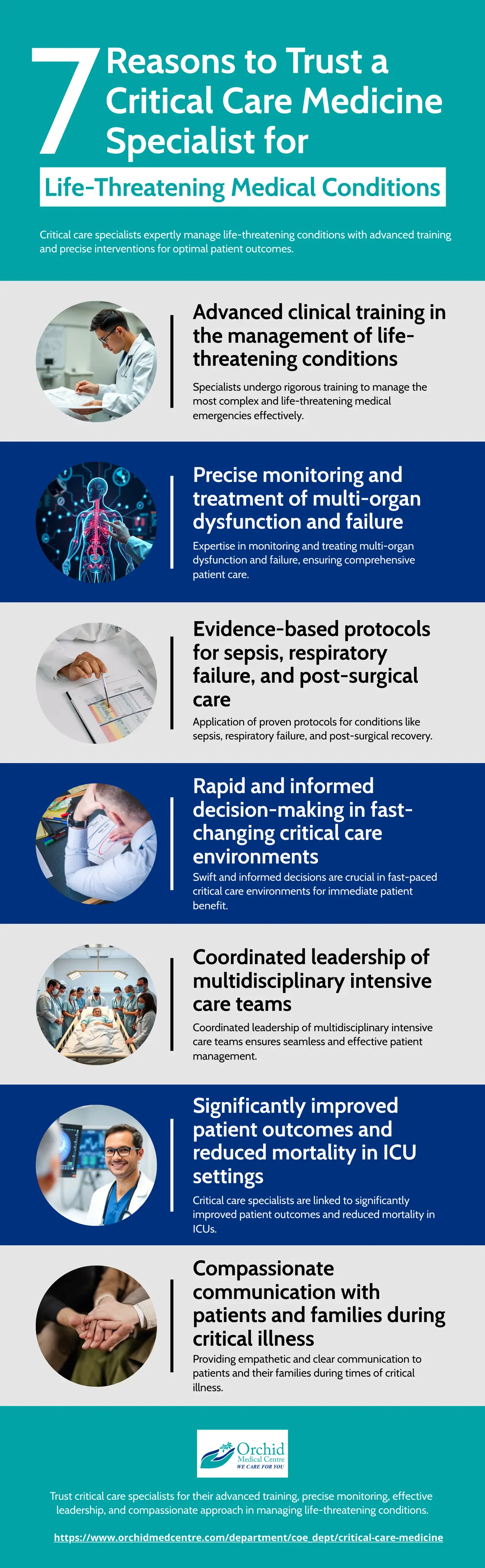
Having access to a qualified critical care medicine specialist provides patients and families with the assurance that the most serious medical situations are being managed by a clinician with the training, experience, and focus required to deliver the best possible outcomes. Below is an infographic outlining seven key reasons to trust a critical care medicine specialist for intensive and life-threatening medical care.


.jpeg)

.jpg)

.webp)
.webp)

.webp)
.webp)






.webp)
.webp)
.jpg)
.webp)
.webp)
.webp)
.jpg)
.jpg)
.jpg)
.webp)
.webp)
.webp)
.jpg)
.jpg)
.webp)
.webp)